Welcome message

Welcome, friends old and new, to my blog. This is the place where I can share my scribblings and thoughts on loving life. I hope you enjoy them, make suggestions and come back to read more.

Saturday, 25 April 2015

Great Fictional Characters: Sam Vimes

Continuing with the Blogging from A to Z April Challenge 2015


V is for Vimes- Sam Vimes.


Ye gods, how do I even begin to try and summarise a character so complex and magnificent as Mister Vimes in only a few hundred words? Perhaps I should start with his own:

"If there was anything that depressed him more than his own cynicism, it was that quite often it still wasn't as cynical as real life."

Sam Vimes is Harrison Ford, Clint Eastwood and Jack Dee rolled into one messed-up (yet still redeemable) Night Watch guard with a short temper and a chip on his shoulder . And I love him for it.

Born in the Shades, from a "too poor to paint; too proud to whitewash" single-parent family, Vimes is now a highly reluctant member of the nobility, with an annoying habit (in his opinion) of collecting titles: currently, he is known as His Grace, His Excellency, the Duke of Ankh, Commander Sir Samuel Vimes. The Patrician of Ankh-Morpork bestows titles on Sam just to annoy him or, possibly, because he thinks it's funny. Sam himself likes to add Blackboard Monitor on the end.

His rise to power came slowly: after many years as captain of the practically-obsolete (thanks to the Thieves' Guild) Nightwatch, Vimes' firm grasp of the nastier side of human nature led to him spending a significant chunk of his adult life as a drunk. The arrival of a dragon, and Lady Sybil Ramkin (not to be confused), kick-started his arc and the creation of one of the best-loved characters on the Disc. The romance between Lady Sybil and himself, unfolding over the course of many books, is the most beautiful yet unsoppy thing I have ever read, and I wish there were a few more like Vimes in this world so I could find one and marry him ;)

But back to the story. Vimes, though loving married life, is not exactly comfortable with his new wealth and status, seeing himself as one of "us" rather than them, and he hates the idea that he might be lumped in with the upper classes, who sneer at those below:

“...the helmet had gold decoration, and the bespoke armorers had made a new gleaming breastplate with useless gold ornamentation on it. Sam Vimes felt like a class traitor every time he wore it. He hated being thought of as one of those people that wore stupid ornamental armor. It was gilt by association.”

 Don't get him started on the tights.

 One of the reasons Vimes is so fascinating to me is his philosophical outlook (except he probably wouldn't call it that, being far too no-nonsense and slightly suspicious of big words). Here's a good example:

Are you feeling lucky?
“The reason that the rich were so rich, Vimes reasoned, was because they managed to spend less money.

Take boots, for example. He earned thirty-eight dollars a month plus allowances. A really good pair of leather boots cost fifty dollars. But an
affordable pair of boots, which were sort of OK for a season or two and then leaked like hell when the cardboard gave out, cost about ten dollars. Those were the kind of boots Vimes always bought, and wore until the soles were so thin that he could tell where he was in Ankh-Morpork on a foggy night by the feel of the cobbles.

But the thing was that
good boots lasted for years and years. A man who could afford fifty dollars had a pair of boots that'd still be keeping his feet dry in ten years' time, while the poor man who could only afford cheap boots would have spent a hundred dollars on boots in the same time and would still have wet feet.

This was the Captain Samuel Vimes 'Boots' theory of socioeconomic unfairness.”


Whenever I read one of the Discworld novels with Vimes, I feel like I balance out a bit. I'm guilty of wanting everything and everyone to be lovely, and I know that makes me hopelessly naïve at times. Vimes is a wake-up call. He sees things as they really are, and sometimes worse than they are (from experience). One of Nature's policemen, nothing can be hidden from him and he knows that you'll slip up sometime. He's probably the reason policemen make me nervous: according to Vimes, everyone is guilty of something.

That's not to say he doesn't have a fun side... oh, how he loves to toy with the Assassins who are sent to kill him (though not anymore: they've decided he's more useful alive than dead- or perhaps they are just embarrassed that they've failed so many times). And when it comes to impersonating animals and well-known Ankh-Morpork residents for the amusement of his son, Young Sam, no one can match him.


“WHERE'S MY COW?!
IS THAT MY COW?!
HRRRUUUUGGGH!!!!
THAT'S NOT MY COW!
THAT'S A HIPPOPOTAMOUS!”


I think his tough exterior, in true trope-style, is only to protect his soft core. His genuine affection for his fellow watchmen, his pride in his city, his unswerving love for his family and his determination to lock up as many bad guys as possible are the actions of a truly compassionate and altruistic man.

In terms of personality, Vimes bears some similarity to Granny Weatherwax (another one of my favourites). They are both hugely intelligent, dryly witty, uncannily observant "good" characters who secretly fear the darkness inside them, and constantly strive to control the more poisonous side of their nature. Granny watches herself constantly for signs of cackling; Vimes for "the Beast".

Quis custodiet ipsos custodies? (Who watches the watchmen?)

Vimes does. Always.

"No excuses. No excuses at all. Once you had a good excuse, you opened the door to bad excuses."

What are your thoughts on Vimes? Is he a moral compass or just a good copper? Feel free to share in the comments below.


Friday, 24 April 2015

Great Fictional Characters: Uriah Heep?

Continuing with the Blogging from A to Z April Challenge 2015


U is for...uh, is for... erm... dammit.


I'm totally busted.

I can't remember any great characters whose names begin with U from books that I've read. Not one. Not a sausage.

But there must be! I hear you cry. In the billions of books ever printed, there simply must have been characters whose names began with the letter U, and, surely, at least one resonated with you? Just a little?

Lovely readers, I'm afraid the answer is no.

With the rest of the A to Z, I've found an abundance of greatness- a cornucopia of corkers. I've struggled to choose between Gandalf and Granny Weatherwax, Tiffany Aching and Tris Prior- even dear old Katniss nearly didn't make the cut- but, when it came to U, I drew a blank. Even Google let me down: the only Us that came up were Lady Una (Stardust: I've seen the film and own the book, but haven't read it yet) and 'gulp' Uriah Heep.

Dickens. 'shudders'
I'm so sorry, Charlie...


I can't be doing with Dickens. I feel incredibly guilty about it: it's like admitting to not liking puppies or tea or the Peak District. Everybody loves Dickens! He's a classic author!

I have tried. I can make it all the way through A Christmas Carol (because it's short and I can imagine the Muppets version) but reading any of his other works feels like force-feeding myself shredded cardboard. A bit harsh, maybe, but a fairly accurate description of the level of my enjoyment.

So today I'm throwing it over to you: what am I missing? Can you convince me to pick up David Copperfield and find out, straight from the horses mouth, who this Uriah Heep chap is without resorting to copying and pasting from an A-level English revision website?

What can Dickens do that other authors can't?

In short, what the Dickens is the fuss about Dickens?

I look forward to reading your comments.

Thursday, 23 April 2015

Great Fictional Characters: Tiffany Aching

Continuing with the Blogging from A to Z April Challenge 2015


T is for Tiffany Aching.


Happy St George's Day! Now, to my knowledge, Tiffany has never battled with a dragon, but she's had her fair share of scary monsters to contend with- and I'm not just talking about the sheep on the Chalk.

In The Wee Free Men, she rescues her brother, Wentworth, from Jenny Green-Teeth (with a frying pan, no less) and then later, when he is kidnapped by the Queen of the Fairies, she marches off to Fairyland to get him back. From the start, Tiffany always rises to the occasion—even if it's not necessarily what she wants to do. She may not like her little brother that much, but she's his big sister, after all, and that means it's her job to make sure he's okay and to bring him home.

“All witches are selfish, the Queen had said. But Tiffany’s Third Thoughts said: Then turn selfishness into a weapon! Make all things yours! Make other lives and dreams and hopes yours! Protect them! Save them! Bring them into the sheepfold! Walk the gale for them! Keep away the wolf! My dreams! My brother! My family! My land! My world! How dare you try to take these things, because they are mine!

I have a duty!

Fresh from that adventure, and having set her mind on becoming a witch, she goes to apprentice with Miss Level and soon lands in trouble again- this time with a hiver. A hiver is a strange parasitic entity that takes over the mind until the body is no use to it- often because that body is no longer breathing... Tiffany eventually manages to banish it from her body, but that's not enough. Knowing it will continue to search for a body to inhabit, she resolves to get rid of it entirely, though not without the compassion of a true witch, the support of a great one, and learning some valuable lessons:

“Always face what you fear. Have just enough money, never too much, and some string. Even if it’s not your fault, it’s your responsibility. Witches deal with things. Never stand between two mirrors. Never cackle. Do what you must do. Never lie, but you don’t always have to be honest. Never wish. Especially don’t wish upon a star, which is astronomically stupid. Open your eyes, and then open your eyes again.”  

Older and wiser, (or possibly not) Tiffany moves on to train with another witch, Miss Treason. Miss Treason takes her to see the Dark Morris, a secret version that balances out the one everyone is familiar with by saying goodbye to the Summer Lady and letting the Wintersmith take his turn on Earth. Entranced by the dancing, Tiffany can't help herself and joins in, drawing the attention of the Wintersmith himself. Intrigued, the Wintersmith pursues Tiffany with the amorous intent and enthusiasm of a teenage boy, his "gifts" becoming more dramatic and dangerous as the season progresses. Tiffany must keep her frozen beau at bay long enough to find the real Summer Lady and complete the Dance of the Seasons before the Wintersmith's love- quite literally- smothers her and the Chalk community she watches over.

"You could say it was unfair, and that was true, but the universe didn’t care because it didn’t know what “fair” meant. That was the big problem about being a witch. It was up to you. It was always up to you.”  

Her most recent adventure, and the one I'm re-reading at the moment, sees her pitting herself against probably the most dangerous opponent yet- the Cunning Man. From being respected and feared (in a healthy way), witches suddenly start finding themselves mocked, accused and even resented. Tiffany learns this is down to the Cunning Man, a demonic spirit of pure hatred, able to corrupt other minds with suspicion and anger. He has it in for witches, big time, and Tiffany is on his hit list. She needs to stop him and the stakes are high: if she fails, the other witches will step in and do whatever is necessary to restore the normal order- even if it means killing her...

“Everybody needs a witch, but sometimes they just don't know it.”  

Tiffany's pretty awesome because she uses her head more than her magic, runs toward her fear instead of away from it and, instead of letting the grown-ups deal with the hard stuff, rolls up her sleeves and gets stuck in. She's not afraid of who she is:

“Yes! I'm me! I am careful and logical and I look up things I don't understand! When I hear people use the wrong words, I get edgy! I am good with cheese. I read books fast! I think! And I always have a piece of string! That's the kind of person I am!”  

What do you think of Tiffany? Let me know in the comments x

Wednesday, 22 April 2015

Great Fictional Characters: Scarlett O' Hara

Continuing with the Blogging from A to Z April Challenge 2015.


S is for Scarlett O'Hara.

 
 “Scarlet O'Hara was not beautiful, but men seldom realized it when caught by her charm as the Tarleton twins were. In her face were too sharply blended the delicate features of her mother, a Coast aristocrat of French descent, and the heavy ones of her florid Irish father. But it was an arresting face, pointed of chin, square of jaw. Her eyes were pale green without a touch of hazel, starred with bristly black lashes and slightly tilted at the ends. Above them, her thick black brows slanted upward, cutting a startling oblique line in her magnolia-white skin-that skin so prized by Southern women and so carefully guarded with bonnets, veils and mittens against hot Georgia suns.”  
 
Oh, to be a southern belle! To drink mint julep on the porch and go to balls! To wear fine dresses and flutter my eyelashes!
 
Obviously, Scarlett manages a little more than that- quite a lot more than that, in fact- and following her as she grows emotionally from a spoiled, selfish little madam who deserves a good slap to a resilient and resourceful woman never fails to be a joy for me. 
 
I love her feistiness, her complete disregard for anyone but herself, her downfall and heart-breaking epiphany. Plus, anyone who can look good in curtains and a cock-feather is a winner in my eyes.
 
Scarlett taught me to act dumb, think smart, flutter my eyelashes and that, after all, tomorrow is another day.

Tuesday, 21 April 2015

Great Fictional Characters: Rincewind

Continuing with the Blogging from A to Z April Challenge 2015


R is for Rincewind.


For those who haven't had the pleasure, Rincewind is a failed student at the Unseen University for wizards in Ankh-Morpork, and is often described by scholars as "the magical equivalent to the number zero". A better athlete than he is magician, he spends most of the Discworld books running away from various groups of people who want to kill him.

Because it's my birthday today, I'm a little short of time, so I thought I'd let the marvellous Sir Terry Pratchett do all the talking.

Here are some of my favourite Rincewind quotes from across the series.

"There are eight levels of wizardry on the Disc; after sixteen years Rincewind has failed to achieve even level one. In fact it is the consideration of some of his tutors that he is incapable even of achieving level zero, which most normal people are born at; to put it another way, it has been suggested that when Rincewind dies the average occult ability of the human race will actually go up by a fraction."

"He'd never asked for an exciting life. What he really liked, what he sought on every occasion, was boredom. The trouble was that boredom tended to explode in your face. Just when he thought he'd found it he'd be suddenly involved in what he supposed other people - thoughtless, feckless people - would call an adventure. And he'd be forced to visit many strange lands and meet exotic and colourful people, although not for very long because usually he'd be running. He'd seen the creation of the universe, although not from a good seat, and had visited Hell and the afterlife. He'd been captured, imprisoned, rescued, lost and marooned. Sometimes it had all happened on the same day."

"Rincewind could scream for mercy in nineteen languages, and just scream in another forty-four."

“Preeminent among Rincewind’s talents was his skill in running away, which over the years he had elevated to the status of a genuinely pure science; it didn’t matter if you were fleeing from or to, so long as you were fleeing. It was flight alone that counted. I run, therefore I am; more correctly, I run, therefore with any luck I’ll still be.”


"Rincewind sighed. He liked lettuce. It was so incredibly boring. He had spent years in search of boredom, but had never achieved it. Just when he thought he had it in his grasp his life would suddenly become full of near-terminal interest. The thought that someone could voluntarily give up the prospect of being bored for fifty years made him feel quite weak. With fifty years ahead of him, he thought, he could elevate tedium to the status of an art form. There would be no end to the things he wouldn't do."

"Multiple exclamation marks are a sure sign of a diseased mind.”

“Luck is my middle name," said Rincewind, indistinctly. "Mind you, my first name is Bad.”

Monday, 20 April 2015

Great Fictional Characters: Queenie

Continuing with the Blogging from A to Z April Challenge 2015


Q is for Queenie.


The seductive and beguiling story of Dawn Avalon, who, when wrongfully accused of a crime she didn't commit, flees her homeland to London where she becomes 'Queenie', a star of both the stage and screen.

I was a teenager when I first read Queenie by Michael Korda, and I loved it. Goodness knows where I found it: growing up, my house was full of books- and car boot sales and charity shops steadily added to the stacks. Books were borrowed, swapped and passed back to car boot sales and charity shops in the never-ending cycle of bibliophiles with limited funds and limited space everywhere.

I kept it for many years, and read it more than once but, sadly, due to moving house a fair few times (and the occasional necessary cull) I don't own it anymore, and so couldn't reread it to prepare for this post. Looking on the web to refresh my memory, I was surprised by all the critical critic's reviews, as I remembered it being an engaging, interesting and (for teenage me) sexy little number that started me off questioning how people judge people and force them to hide a "shameful" past that I didn't consider shameful at all.

But then I clicked on the reader reviews (arguably the only ones that truly count) and I found I wasn't alone.

...a delight from start to finish.

You can't help being fascinated by Queenie/Dawn and the way she survives through the abuse of the old, british powerful Mr. Rumsey and the hate of his daughter Prunella.

I enjoyed the book immensely, personally identifying with the heroine's struggle to discover exactly what mold she's "caste" in as well as her personal and political victories over prejudice & racism in the industry.

(reviews from Amazon.com)

So is it good or not? To quote Queenie:

“It must be nice... to be one thing or another, to know where you belonged.”

But so few people, or reviews, are.

Although my recollection of the plot beyond what has already been described is hazy, I do remember rooting for Queenie on every page, furious at the ones who tried to take advantage of her and cheering when she got the better of them. One scene, where a photographer changes the lighting to mask scars on her face, stayed with me, (because it was so kind) as did her decision to not have children, lest her secret be revealed in their skin colour (because it was so cruel). The most moving part was where she finally admitted (even the word admitted implies shame) her Indian heritage and the world didn't end.

Queenie is out of print now (and I'm kicking myself for losing/giving away my copy) but, if you can find it, I think you'll enjoy it.


Saturday, 18 April 2015

Great Fictional Characters: Pop Larkin

Continuing with the Blogging from A to Z April Challenge 2015


P is for Pop Larkin.


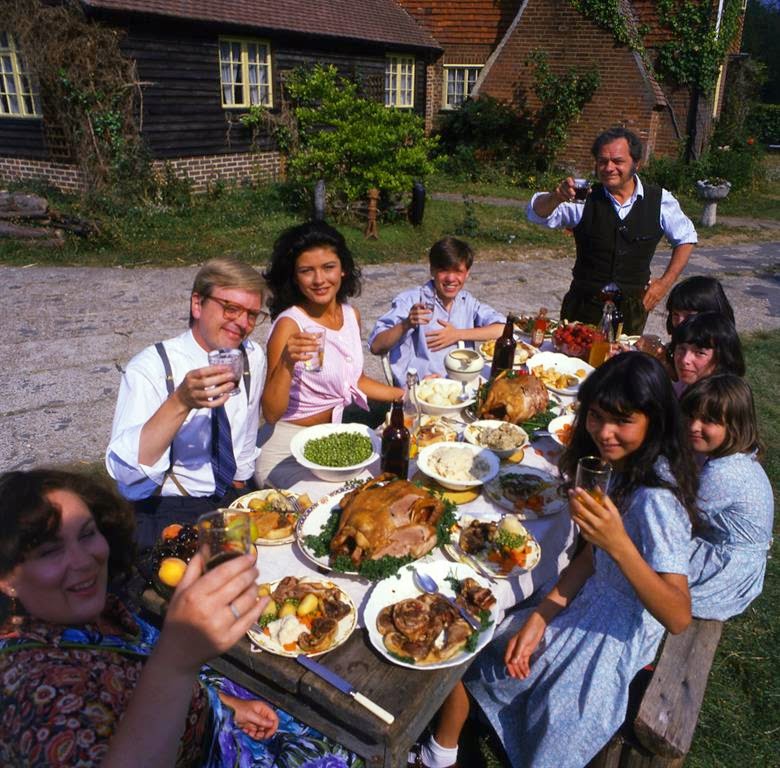
Like most people in their 30s, the name Pop Larkin immediately brings a face to mind. Not only a face, but a grin, a raised eyebrow and a wicked belly-laugh.

David Jason was the perfick Pop in the TV adaptation of The Darling Buds of May and is the reason that many, like me, searched out and read the novels in the first place. In them, I found not only evocative description, witty dialogue and nostalgia for an England I never knew, but a philosophy for life- a recipe for happiness, if you will.

It is impossible now for me to read about Home Farm without picturing this

Pop and his family live in the Kent countryside, where everything is beautiful, golden and ‘perfick’, as Pop likes to say. Happiness is everywhere: he only needs to cast his eye over the green fields, the flowers in the hedgerow or listen to the nightingales sing. Pop wants us to enjoy the simple pleasures of nature as much as anything we could buy.

I feel sure Pop is a fellow Taurean as we're very into indulging our senses. According to Pop, homes should be comfortable, cars should be stylish, food should be tasty and plentiful, and alcohol should be shared with friends- and often! Life is bountiful and meant to be enjoyed, as much as and often as you can.

Pop lives by the motto that ‘whatever will be will be’. He finds happiness by simply refusing to fret about the little things and understanding that life is too short to spend it worrying. It puts me in mind of the Serenity prayer- you know the one:

God, grant me the serenity to accept the things I cannot change,
The courage to change the things I can,
And the wisdom to know the difference.
 
The Darling Buds of May is no moral lecture. Instead of Pop getting his come-uppance in the form of a visit from the tax-man, he continues eating, drinking and being merry right up to the end of the story.

What would Pop want us to learn from this?

Answer in the comments- and enjoy your day xxx

Friday, 17 April 2015

Great Fictional Characters: Om

Continuing with the Blogging from A to Z April Challenge 2015


O is for Om.


“...gods like to see an atheist around. Gives them something to aim at.”

On the Discworld, gods are real. Like, really real, as in only a fool would deny a god's existence because a) it would be like denying the existence of the postman and b) there's a good chance they'd find out and come round to have a word.

“Gods?” said Xeno. “We don’t bother with gods. Huh. Relics of an outmoded belief system, gods.”
There was a rumble of thunder from the clear evening sky.
“Except for Blind Io the Thunder God,” Xeno went on, his tone hardly changing.”
  

But there's a catch: the greater the belief, the more powerful the god... and vice versa. But belief is not the same as religion:

“Belief shifts. People start out believing in the god and end up believing in the structure.”  

Soooo, when the church of Om gets so tangled up in schisms and rules and rituals that it forgets the god in whose name they're arguing, and he decides to go down and sort it all out, he doesn't manifest in quite the form he'd expected.

On the Disc, instead of being a shimmering, golden figure to inspire awe and wonder, the Great God Om is a tortoise.

“You can't trample infidels when you're a tortoise. I mean, all you could do is give them a meaningful look.”

His second job, therefore, (the first being to find someone who actually, truly believes in him and not just all the hype) is to convince Brutha (an bona-fide believer) of his credentials.

"It's a big bull," said the tortoise.
"The very likeness in the Great God Om in one of his worldly incarnations!" said Brutha proudly. "And you say you're him?"
"I haven't been well lately," said the tortoise.

With Brutha as the Chosen One he wouldn't necessarily have chosen, Om has to learn how to reengage with his followers in order to inspire greater belief and, in the process, help them reform the church to be more open-minded and humanist, and a lot more sensible.

I heartily recommend you read Small Gods by Terry Pratchett for some laughs and a touch of philosophical thinking.

Thursday, 16 April 2015

Great Fictional Characters: Nancy Blackett

Continuing with the Blogging from A to Z April Challenge 2015


N is for Nancy Blackett, the star (as far as I'm concerned) of Arthur Ransome's Swallows and Amazons.


Independent, self-reliant and unafraid of anything or anyone (except, possibly, her Great Aunt), Nancy is a great heroine, especially when you consider the roles to which young girls were supposed to aspire in the 1930s. Where Susan lovingly mothers the other children and gets them out of trouble in a very sensible way, Nancy is all about instigating the action that gets them into trouble in the first place.

"It's much more fun being sea-dogs and timber shiverers."


As a child, reading the books, I envied Nancy's confidence and independence. The Swallows, as much fun as they were, were just a little too sensible for me. I craved the wild adventures Nancy promised (and delivered) and desperately wanted to wear a red cap and frighten boys with my daring. Some have called her a "tomboy"; others, a "subversive character for girl readers" (yes, really!) but I call her a legend.

Every day is an adventure with Nancy and, if it's not, she does her best to make sure it will be. She revels in the fantasy world she has created, where tourists are pirates, neighbours are natives and a local mountain is far-off Kanchenjunga.

"Let's broach a puncheon of Jamaican rum... It's really good stuff. Sometimes our cook is quite friendly, for a native. She calls it lemonade."

Her "flexible honesty" (what an amazing phrase) keeps grown-ups off her back without her ever resorting to outright or unkind lies and, despite pretending to be ruthless, she actually cares very much for her family and friends. A free spirit, she "lives in the now" and doesn't think too seriously about the future, unless it involves living on Wild Cat Island forever.

"Well, we shan't be at school forever," said Nancy. "We'll be grown up, and then we'll live here all the year round."

Unlike most of the other characters in Swallows and Amazons, Nancy appears to not have been inspired by a real person, with Ransome only saying that he once saw two young girls wearing red caps playing one day. However, he was so taken with the character that he named his 28ft cutter "Nancy Blackett" and sailed her for three years. Even better, I found out that she was built in 1931 by Hillyard of Littlehampton- my home town!

Swallows and Amazons is a classic for many reasons, not least for its innocence and charm, as well as the vivid descriptions of the landscape in which the adventures are set. But, for me, it will forever be a firm favourite because of Nancy.

Wednesday, 15 April 2015

Great Fictional Characters: The Amazing Maurice

Continuing with the Blogging from A to Z April Challenge 2015


M is for Maurice or, to give him his full title, The Amazing Maurice.


We've all heard about the Pied Piper of Hamelin, where a plague of rats descends on a small village...

"You didn't need many rats for a plague, not if they knew their business. One rat, popping up here and there, squeaking loudly, taking a bath in the fresh cream and widdling in the flour, could be a plague all by himself."

...and, when the people of the village demand action, the mayor calls in an expert...

After a few days of this, it was amazing how glad people were to see the stupid-looking kid with his magical rat pipe. And they were amazed when rats poured out of every hole to follow him out of the town.

...but do you know the whole story?

Artist credit

"They were so amazed that they didn't bother much about the fact that there were only a few hundred rats.

They'd have been really amazed if they'd ever found out that the rats and the piper met up with a cat somewhere in the bushes out of town, and solemnly counted out the money."

Maurice is no ordinary cat. He's the mastermind behind a scam so sweet that he's surprised no one has thought of it before. After becoming sentient due to a magical mishap, he rounds up a clan of similarly intelligent rats and sets off to make his fraudulent fortune.

All goes well until they reach the town of Bad Blintz, where an altogether more malignant trick is being played, and The Amazing Maurice and his Educated Rodents, along with Keith (the stupid-looking kid) discover they may have bitten off more than they can chew...